"Just overnight, people have lost 20-plus feet of frontage from the collapse of the bluff, so it's something that you can't really anticipate." That's Saugatuck Township Manager Daniel DeFranco, describing why the township spent four months in early 2025 with building and zoning permits frozen along the entire Lake Michigan shoreline. The freeze ended on April 24, 2025, when the Lakeside Overlay District Ordinance took effect. Most of the coverage at the time framed it as an erosion story. For anyone buying or selling on the Lakeshore Drive corridor right now, it's actually a property story, and a more interesting one than the headlines suggested.
The ordinance didn't just add paperwork to future construction. It drew a line at April 24, 2025, and split every waterfront lot in Saugatuck Township into one of two categories: what was built before that date, and what can legally be built after it. Those two categories are not the same product anymore, and treating them as interchangeable is the mistake I want to help you avoid.
What Actually Changed West of Lakeshore Drive
The Saugatuck Township Board approved the ordinance on April 9, 2025, following the four-month moratorium DeFranco referenced. It rezoned every parcel west of Lakeshore Drive, from the township's northern boundary near 130th Avenue and Wiley Road down to the southern boundary at 124th Avenue and M-89, into a new Lakeside Overlay District. Any construction, land movement, or accessory structure in that district now requires a zoning permit under the new standards, on top of whatever state and federal approvals already applied.
The development standards themselves are specific enough that they change what a lot can physically become:
- Lot coverage capped at 40 percent of the buildable area, excluding setbacks and the land between the bluff and the erosion hazard line
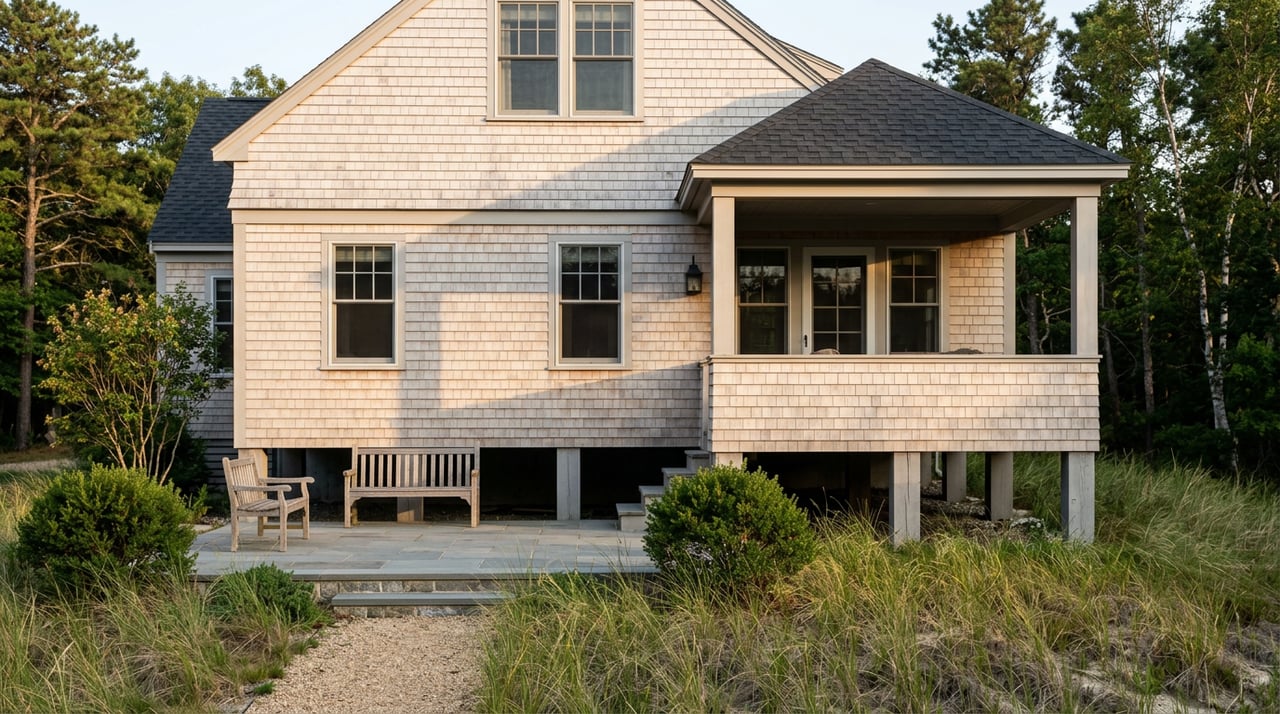
- Basements prohibited outright, meaning new construction must sit on a crawlspace or pilings
- Waterfront setback set by the 60-year erosion recession line as mapped by the state's environmental agency, with a 15-foot side setback and a 40-foot front setback
- No fences or walls permitted in the waterfront yard
- Driveways and hard surfaces must be permeable and kept outside side yard setbacks, and private roads are prohibited
- Earth movement limited to within 10 feet of the building footprint
- Grading and drainage plans must carry the seal of a licensed Michigan engineer
- Trees over 8 inches in diameter can only be removed for cause, such as disease, and roots have to stay in place
- Underground irrigation systems and in-ground pools are prohibited entirely
That last point is where most buyers stop and reread the sentence. A pool is not a minor amenity on a waterfront estate. It's often part of the reason the property commands what it does.
The State Permit You Already Knew About, and the Local One You Didn't
Buyers who've shopped Great Lakes shoreline before usually know that Michigan's Critical Dune Area program, administered by the state's Department of Environment, Great Lakes, and Energy, has required a permit for house construction, driveways, septic systems, and retaining walls in designated dune areas since the state legislature finalized its critical dune maps in 1989. That layer hasn't gone anywhere. What's new is that Saugatuck Township has now stacked its own overlay district on top of it, with standards that are, in several respects, tighter than the state's baseline.
That stacking matters for timeline and cost. A project on Lakeshore Drive today needs to clear the Township's Lakeside Overlay District review in addition to any state critical dune permit that already applied to the parcel. Two approval processes, two sets of standards, and two agencies that don't automatically talk to each other about your project.
Why April 24, 2025 Split the Market in Two
Here's the part that doesn't show up in a listing description. Michigan zoning law generally treats a structure that lawfully existed before a zoning change as legally nonconforming. It can stay. It usually can't be rebuilt in kind if it's voluntarily removed or destroyed beyond a certain threshold. Apply that principle to the Lakeside Overlay District, and a pool poured in 2019 is not the same asset as a pool proposal submitted in 2026.
Built or permitted before April 24, 2025 | Proposed after April 24, 2025 | |
|---|---|---|
In-ground pool | May remain as a legal nonconforming structure | Not permitted |
Basement | May remain | Not permitted; crawlspace or pilings required |
Fence or wall in waterfront yard | May remain | Not permitted |
Driveway surface | May remain as built | Must be permeable, outside side setbacks |
Lot coverage | Existing coverage may exceed the new cap | Capped at 40 percent of buildable area |
A lot with an existing pool, a poured basement, and a fenced yard didn't just get grandfathered rights. It got features that cannot be recreated anywhere else in the district going forward. That's a genuine scarcity argument, and it cuts against the assumption that older waterfront homes are simply due for a teardown and rebuild. On this stretch of shoreline, the teardown option now buys you less house than the original did.
Raw land and rebuild candidates aren't worthless by comparison. They're a different product: lower maintenance liability, likely lower insurance friction since there's no legacy pool or basement to worry about during a bluff event, and a cleaner permitting path since there's nothing nonconforming to untangle. But they will never be built out to pre-2025 specifications, and that permanence is the trade a buyer is actually making, whether or not anyone points it out during a showing.
This Is Not an Isolated Rule
Saugatuck Township didn't invent shoreline caution in 2025. In February 2024, state and federal regulators denied permits for a marina basin proposed by North Shores of Saugatuck on land bordering the Kalamazoo River and Lake Michigan, citing permanent impacts to critical dune habitat and effects on public and tribal river rights. That denial followed a Michigan Supreme Court case decided in 2022, Saugatuck Dunes Coastal Alliance v. Saugatuck Township, which clarified who has standing to appeal local zoning decisions on shoreline development. The Saugatuck Dunes Coastal Alliance, the group behind that appeal, has spent decades pushing back on shoreline projects it views as risky.
The pattern across a marina denial, a Supreme Court standing case, and now a township-wide overlay district points the same direction: oversight on this stretch of Lake Michigan has been tightening for years, not loosening. That's the context that makes pre-2025 nonconforming rights worth paying attention to rather than treating as a footnote. If the trend continues, and DeFranco's comments about a Lake Michigan low-water cycle suggest the township expects it will, grandfathered features become harder to replicate with each passing regulatory cycle, not easier.
What This Means at the Closing Table
If you're evaluating a Lakeshore Drive property right now, a few questions belong in your due diligence before the property goes under contract:
Confirm with the Township zoning administrator whether any pool, basement, fence, or driveway on the property predates April 24, 2025, and whether it's documented as a legal nonconforming structure. Verbal assurance from a seller isn't the same as a paper trail.
Ask what happens if that nonconforming feature is damaged. A basement that floods in a storm event, or a pool cracked by ground movement near the bluff, may not be rebuildable to its current form under the new standards. Understanding that risk before closing, not after a claim, changes how you think about insurance and reserve funds.
If you're building new or buying a teardown candidate, budget the extra time for two separate permit reviews rather than one, and confirm early which of your plans, a driveway, a retaining wall, a proposed patio, actually fits inside the 40 percent lot coverage cap once setbacks and the erosion hazard line are subtracted from the parcel.
A Couple of Questions Worth Asking Directly
Does this ordinance apply to my property if I'm on Lakeshore Drive but on the inland side, not directly on the water? The overlay district applies specifically to land west of Lakeshore Drive within the township boundaries described above. Properties east of the road, or outside the north and south boundary lines, fall under the township's standard zoning rather than this overlay. Confirm your parcel's exact position with the Township directly, since boundary lines matter more than street address here.
If I remove a nonconforming pool to update it, do I lose the right to have a pool at all? Based on how Michigan zoning law generally treats nonconforming structures, voluntary removal can forfeit the right to rebuild under the new standards, which currently prohibit new in-ground pools entirely in this district. Verify the specifics with the Township zoning administrator before removing or substantially altering any grandfathered feature.
If you're weighing a Lakeshore Drive purchase, or wondering what your own waterfront property's grandfathered status might be worth in this market, I'd like to walk through it with you directly. Let's Connect, and we'll look at what this ordinance actually means for the specific parcel you have in mind.